I have a client, Ross McConnell, who has a name for everything. Drama triangles. Back-channelling authority. The man is a walking index of behavioural frameworks I hadn't heard of until I met him.
Last week he introduced me to Parkinson's Law in business.
What is Parkinson’s Law?
Cyril Northcote Parkinson coined it in 1955: work expands to fill the time available for its completion. Ross had been talking through it with his team, posted about it on LinkedIn, and when we caught up it came up in conversation.
The moment he said it, I had one of those instant recognition moments. I've been watching this play out in businesses for 20+ years, and I hadn't had a name for it until now.
Here's what it looks like in practice.
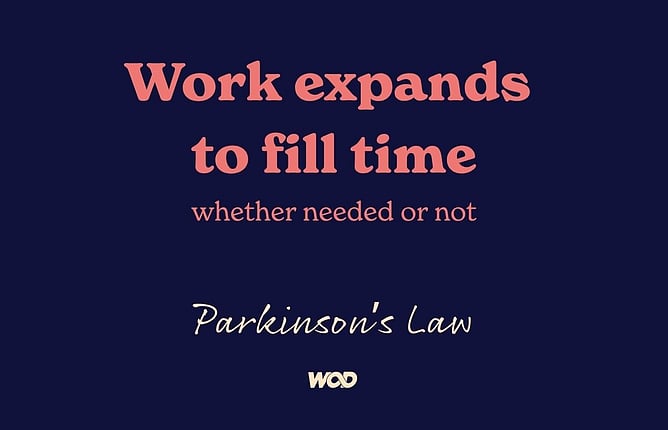
What Parkinson’s Law looks like inside a business
You have a team member sitting in a seat. They're good. They're genuinely trying. But the expectation is that they show up for 40 hours a week, so they do. The work moulds itself to that space. Tasks take longer. Decisions get drawn out. Meetings that could be an email happen anyway. Not because anyone's being lazy – but because the container is 40 hours, and work fills it.
Now flip that. Take someone who works across three clients, has 15 hours allocated to you, and is accountable for specific outputs. Suddenly the container is completely different. The work doesn't have room to expand. It either gets done or it doesn't, and everyone knows which one it is.
Why the Fractional CMO model works differently
That's the Fractional CMO model in a nutshell. Not because it's a clever construct – but because it's how I'm wired.
My Gallup strengths are Strategic, Focus, Achiever, Activator, Discipline. I have always, genuinely, struggled with the concept of sitting in an office for eight hours because that's what you're supposed to do. My husband – very early on in our relationship – called me a job whore. Not mean-spirited, just accurate. I'd step into a role, figure out what needed to be done, do it, and then be ready to move on. Nine to twelve months, usually. I wasn't bored. I'd just finished.
I process quickly. I make decisions. I move forward. And I've never been able to pretend otherwise just to fill a chair.
The businesses I work with are paying me for what I produce, not how long I sit there producing it. My retainer is scoped around outputs and strategic leadership. If I can deliver a quarter's worth of marketing momentum in three sharp weeks because I'm focused and the boundaries are clear – that's not a problem. That's the point.
The question worth asking about your own team is this: what are you actually paying for?
Are you paying for presence or performance?
If someone can do the work in six hours but they're paid to be there for 40, where's the accountability for the output? Is the role genuinely a 40-hour-a-week role, or is it a 20-hour role that's been given room to breathe?
I want to be clear, this isn't a people problem. Most people are genuinely trying to do a good job. But a lot of them are working inside systems that were built for a different era of work, and nobody's questioned the container.
The traditional model says: be here, be present, be available. The better question is: what are you here to achieve, and have you achieved it?
Pay people on what they deliver. Set the outputs clearly. Give them the autonomy to get it done in the time it actually takes. Some people will thrive. Others will reveal that they needed the structure of 40 hours to feel productive, and that tells you something useful too.
And the next time you're thinking about hiring for your marketing function – stop and ask whether the role genuinely requires a full-time person in a seat, or whether what you actually need is a senior leader who understands what's needed and how to deliver it.
Because if the latter is true, you might not need someone full-time. You might just need someone focused.
FAQs
What is Parkinson’s Law in business?
Parkinson’s Law states that work expands to fill the time available. In business, this often leads to inefficiency, longer timelines, and unnecessary costs.
Why do businesses overpay for time instead of results?
Many roles are structured around hours rather than outputs, which allows work to stretch rather than be completed efficiently.
How does a Fractional CMO reduce inefficiency?
A Fractional CMO works within defined time and output constraints, focusing on results, momentum, and accountability rather than time spent.