Experiencing The Wall Walk, May 2024, in my Board role with Sport Waikato
When I worked at the University of Waikato, we learnt about Te Tiriti o Waitangi. That was 20 years ago, and I now realise how much I didn’t understand.
While on the board of Sport Waikato, I was invited to participate in The Wall Walk. This was an immersive workshop exploring Māori history and the evolving relationship between Māori and the Crown in Aotearoa.
The opportunity presented, and I jumped. Having learnt Māori through school (to current-day Year 11 level), I understand pronunciation and words. But as a business leader and board member, I knew I was missing a crucial link.
Leadership in Aotearoa cannot be separated from Māori history. Whether we’re running businesses, sitting on boards, shaping strategy or influencing communities, we operate within a cultural context shaped by Te Tiriti o Waitangi and generations of Māori–Crown interaction.
Understanding that context is part of doing the mahi.
Māori history is not a side conversation
While our tamariki are becoming more familiar with Māori language throughour their years at school, we have a generation of business leaders who are often unsure of Māori culture in business.
They’re unsure what to say.
Worried about getting it wrong.
Concerned it might feel political.
But Māori history is not a political trend. It is the foundation of our country.
If we want te reo Māori and tikanga Māori to remain living parts of Aotearoa, not museum pieces, then leaders must engage with them in real and practical ways.
We need to get involved and participate.
The Wall Walk, a learning through experience
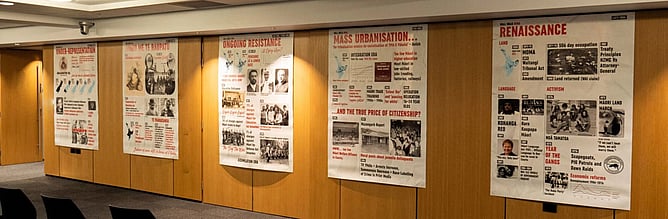
The Wall Walk, facilitated by Dr Simone Bull, is a room-based journey through key moments in Māori history. Participants move along a timeline, engaging with events that shaped the relationship between Māori and the Crown.
It is immersive, not performative.
There is no blame.
No agenda.
No dramatics.
Just mātauranga Māori presented clearly and thoughtfully.
During our Sport Waikato session, we were divided into groups and asked to present back sections of history. Some used visual timelines. Others sang waiata. Some reconstructed events collaboratively.
Teaching the material back to the group deepened the learning. It moved us from passive listeners to active participants.
Why this strengthens our global identity
There is a deeper layer to this. Māori culture makes New Zealand unique on the global stage.
Our language, our tikanga, our understanding of whānau, mana and whenua, these are not liabilities. They are strengths.
Businesses that confidently incorporate te reo Māori and acknowledge tangata whenua are not weakening their brand. They are strengthening it.
They are signalling identity.
They are grounding themselves in place.
They are leading in a way that reflects Aotearoa, not a generic Western template.
Doing the mahi
We often talk about “doing the mahi” in business.
Putting in the work.
Taking responsibility.
Following through.
For me, immersing myself in Māori history through The Wall Walk was part of that mahi. It opened a door to deeper learning. And as leaders, we should never stop learning.
If we want stronger organisations, stronger communities and better outcomes for Māori, then the work begins with understanding.
And understanding begins with showing up.
For leaders and board members committed to understanding Te Tiriti o Waitangi in a practical way, The Wall Walk is a powerful starting point. It creates space for honest learning and shared understanding at leadership level. If you have the opportunity to participate, I would strongly encourage you to do so.
Jacqui Gage-Brown
📷 My Wall Walk experience with Sport Waikato. NZ is where I live and lead, understanding our history is part of doing that well.